
Blog
Why Life Changes Make Everyday Routines Harder (And What to Do About It)
Have you ever felt like you used to be good at this “adulting” thing, and now you just aren’t? Maybe your morning routine ran like clockwork…
Have you ever known exactly what you needed to do, but struggled to get yourself to do it?
You might assume you need to get better at planning, time management, or organization. While that may be true, often times that is only part of the reason you are having trouble starting and following through on tasks.
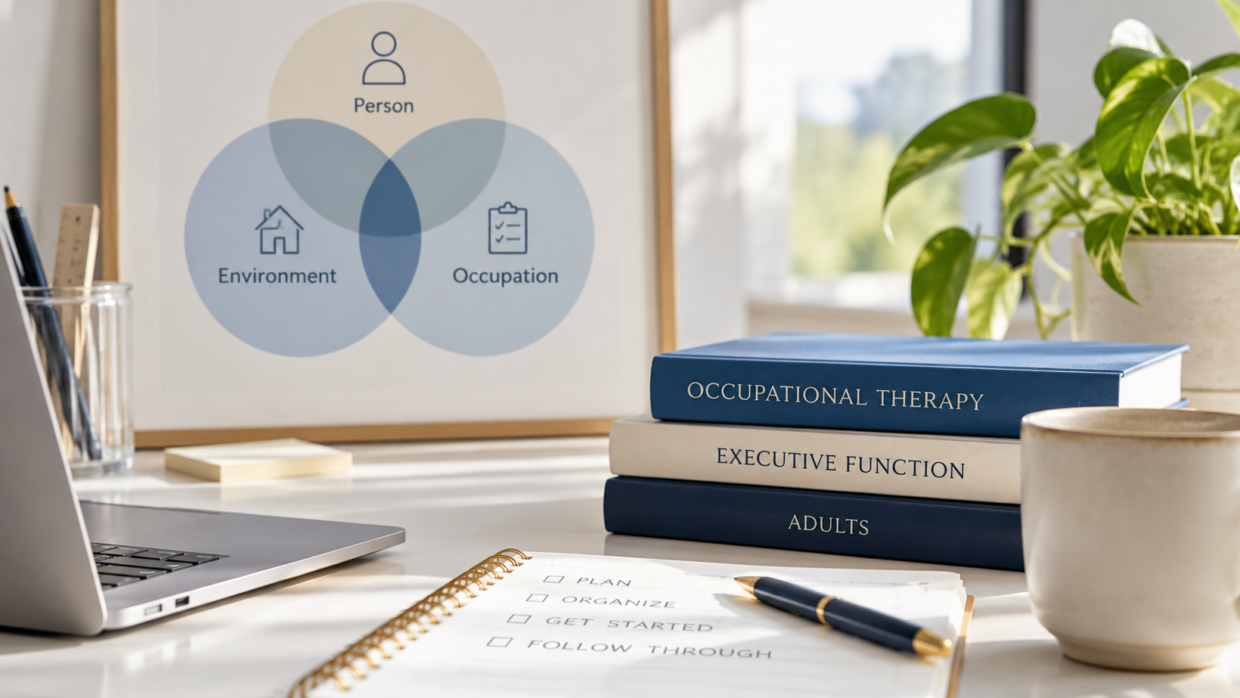
Our ability to plan, organize, and get things done doesn’t happen in isolation. It is influenced by who we are, the environments we work and live in, and the demands of the tasks we’re trying to complete.
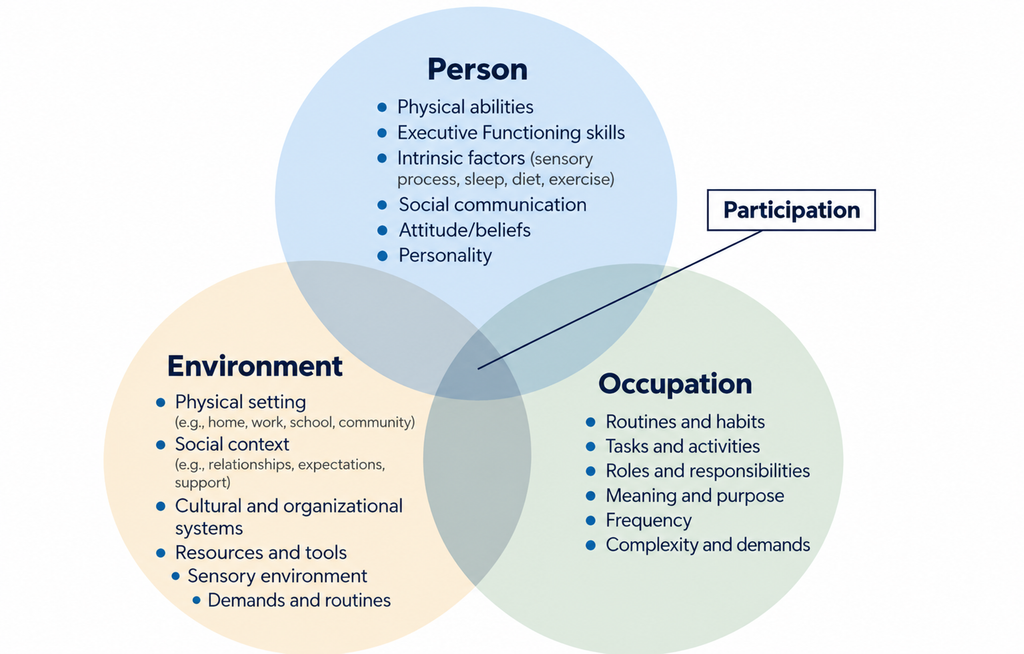
This is where occupational therapy offers a different lens. The OT framework I use is called the PEO (person, environment and occupation) model.
In order to help people turn intention into action you need to be able to identify exactly what is getting in the way of task competition. Executive functioning challenges are only part of the picture. It is my job to understand the whole picture- what about the person, their environment and the task (also known as occupations) are influencing getting tasks done.
A senior software engineer came to me because he felt like he wasn’t getting enough done at work.
At first, this sounded like an executive functioning problem.
As we talked I discovered that he was sitting and staring at his screen and not getting his work done. He was only able to get his work done under a deadline.
Still sounds like executive functioning doesn’t it?
Upon digging deeper we realized he was sitting and staring at his screen because he didn’t know what to do and needed to ask for help.
He reflected that he didn’t ask questions for a multitude of reasons:
In conclusion, when it came to questions, he didn’t know what to ask or when to ask them. However, the answers to these questions would give him clarity on his next steps which would allow him to get started quicker and use his time more efficiently.
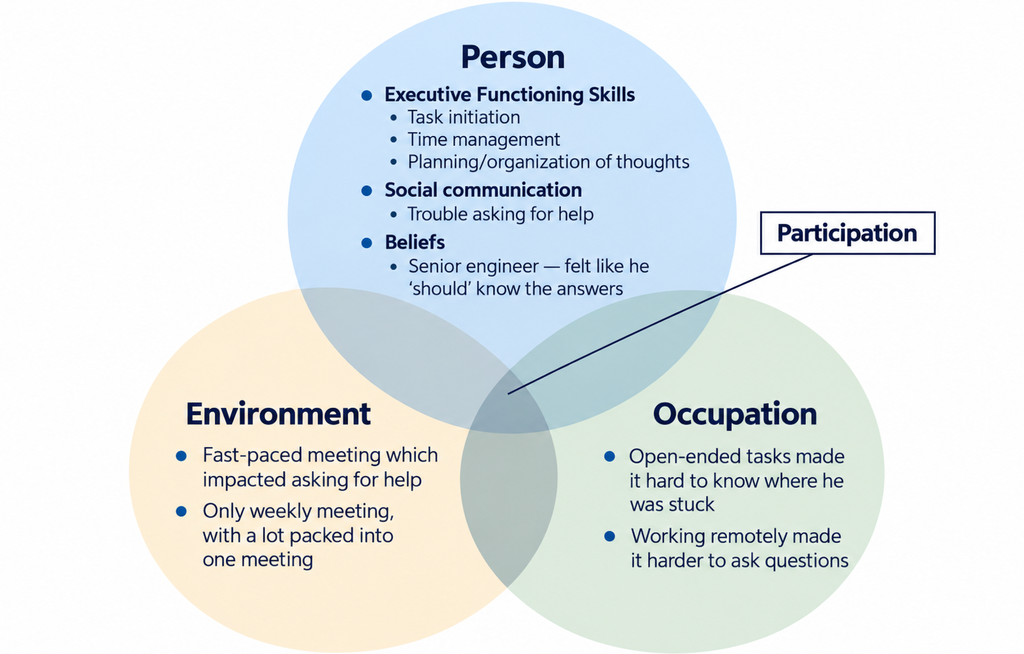
This is why using the occupational therapy lens is so powerful. If we had focused only on executive functioning skills, I might have missed an important part of what was getting in his way.
By looking at the whole person, we could develop a deeper understanding of all the factors that were impacting task completion.
In turn, that understanding changed the strategies we choose..
That’s the value of an occupational therapy lens: understanding how the person, their environment, and the task demands interact so we can build strategies that truly fit.
If you are interested in understanding more about my approach please click “book a consult” on my website to schedule a free 30 minute informational call.
Have you ever felt like you used to be good at this “adulting” thing, and now you just aren’t? Maybe your morning routine ran like clockwork…
Before you try to fix procrastination, it helps to understand what’s getting in the way.
If you are tired of forcing yourself through systems that do not fit, AEO Coaching can help you look closer at what is happening and build a more sustainable way forward.
Book a Consult